Guangzhou, China
Import and Export Commodity Trading Exhibition Hall Zone B
Date: November 18-20, 2026


In 2025, the market vitality of China's wide format printing industry will continue to be released, the process of industrial upgrading will significantly accelerate, and the overall development trend will remain stable and positive. To gain a precise understanding of the overall development of the industry,Shanghai Advertising Equipment Suppliers Association (CSA)United international authoritative market research institutionsWinning Ship Company (Keypoint Intelligence)Jointly initiate the special questionnaire survey on China's wide format printing industry. A total of 2815 valid questionnaires were collected in this survey, and the respondents were all professionals from upstream and downstream industries. The following text will be based on the core data of China's wide format printing market in 2025 formed by this survey, deeply dissecting the current competitive landscape of the industry and looking forward to future development trends.
This survey shows that the surveyed enterprises are mainly small and medium-sized, with an average of 171 employees. 72% of enterprises have 99 or fewer employees, and the industry is still dominated by small and medium-sized enterprises; The average annual turnover of the enterprise is about 6.9 million yuan, mostly concentrated in the range of 1 million to 5 million yuan. The overall operation is stable and in the growth stage.
The respondents cover various core management positions in the enterprise, with production, equipment, procurement, and sales department managers accounting for the highest proportion. The sample has strong representativeness in operational management, and the research results have high reference value.
Firstly, we asked the respondents about the types of products they produce, with the most common being sportswear and workwear. These product categories reflect strong demand in the performance apparel and industrial apparel sectors, which typically rely on fast delivery and highly customized printing processes.
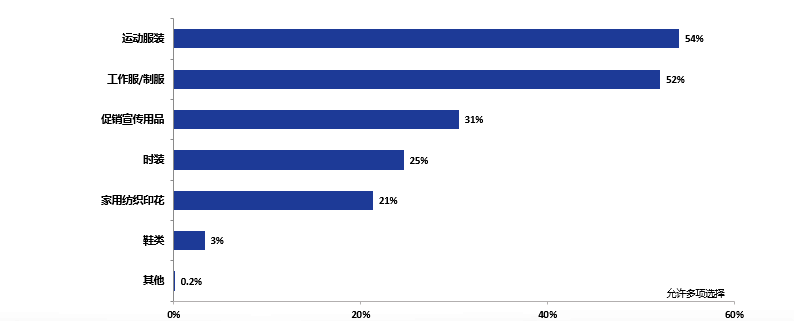
The picture shows the production type of the product
Although textile and clothing printing companies use a variety of technologies, Doufen (DTF) and ready to wear printing (DTG) are the two most popular types of technologies. These digital printing methods can achieve fast preparation, reduce waste, and are particularly suitable for short form production, which is highly in line with the current market trend towards high customization, reduced inventory risks, and faster delivery cycles.
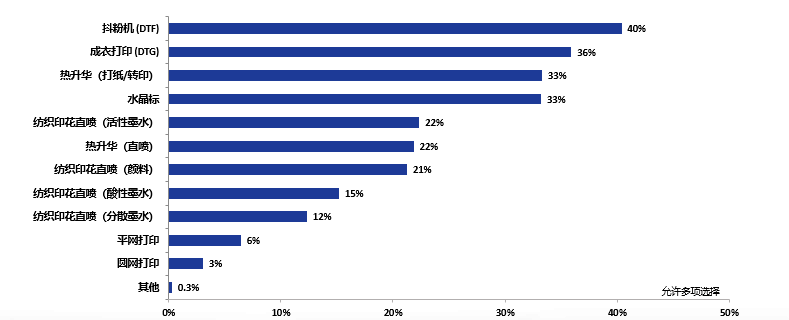
The picture shows an overview of device usage
Next is the data that everyone is most concerned about. Respondents from textile and clothing printing companies have reported that the most planned purchases in the next two years are ready to wear printing (DTG) and shaking powder (DTF) equipment. These two types of devices are also currently the most commonly owned device types. It can be seen that the existing equipment foundation is very consistent with future procurement intentions, and major enterprises have great confidence in the practicality of these devices in the future, especially in short version production and e-commerce driven production models.
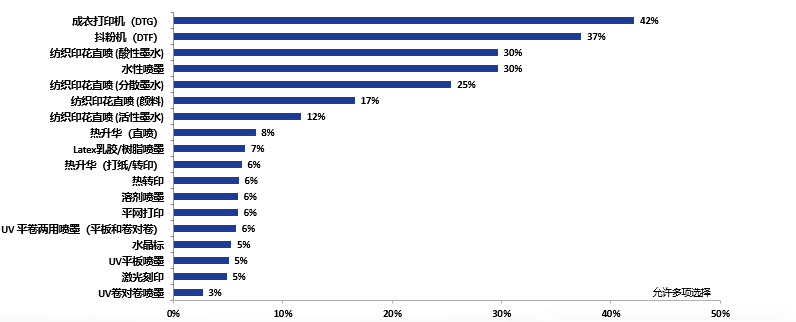
The picture shows the equipment purchase plan
The main driving factors for purchasing new printing equipment include reducing operating costs, improving print quality, and enhancing printing capabilities on new media. withTechnology lifecycleContinuously shortening and increasing performance requirements, printing service providers are inclined to choose devices that can provide higher economic flexibility and wider application coverage.
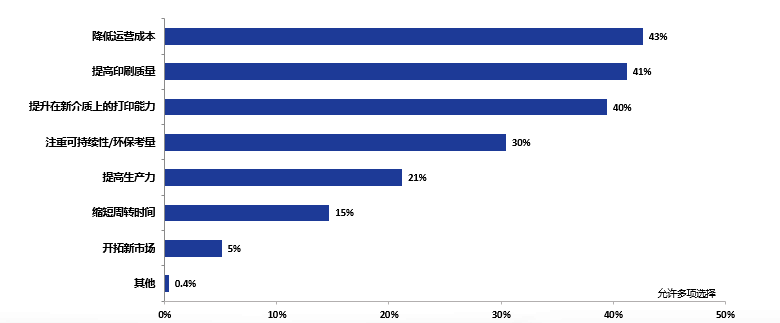
The picture shows the main driving factors for purchasing
Next, let's take a look at the data provided by respondents of label and logo printing companies. Among these enterprises, the most commonly produced items include outdoor signage (48%), banners (47%), and internally illuminated light boxes (46%). These applications remain a core component of the field of identification.
In the field of signage and identification printing,Water-based inkjetIt is the most widely used, followed by thermal sublimation (direct injection) and shaking powder machine (DTF). Even with updated technology, water-based inkjet still has the advantage of its extremely high cost-effectiveness, continuing the industry's dependence on it. The high ranking of sublimation technology also reflects the continuous growth of fabric display applications.
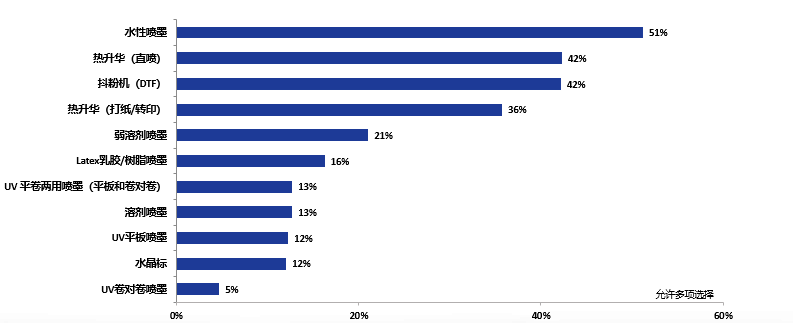
The picture shows the type of device usage
When asked about the changes in printing volume of various printing devices over the past year, most respondents stated that the printing volume has increased or remained unchanged. The stability of this printing volume indicates that PSP (Printing Service Providers) for signage and identification are in a market environment with strong demand resilience. There are two reasons for this situation. Firstly, the demand for promotional labels is cyclical and repetitive; Secondly, high-frequency but small quantity marketing activities are the future development direction of the market.
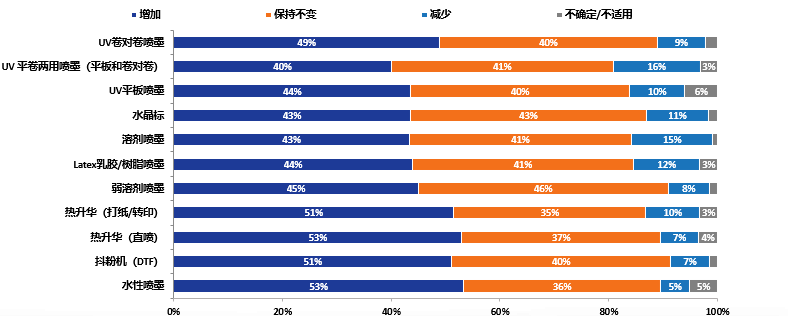
The picture shows the variation of device print volume
Regarding the recent procurement plans of the interviewed companies, only 2% of the respondents stated that they have no procurement arrangements in the short term. This indicates that the market has a high degree of liquidity, and most companies are actively evaluating the possibility of technology update cycles or capacity expansion. The strong interest in DTF equipment also reflects the close relationship between label and identification printing enterprises.
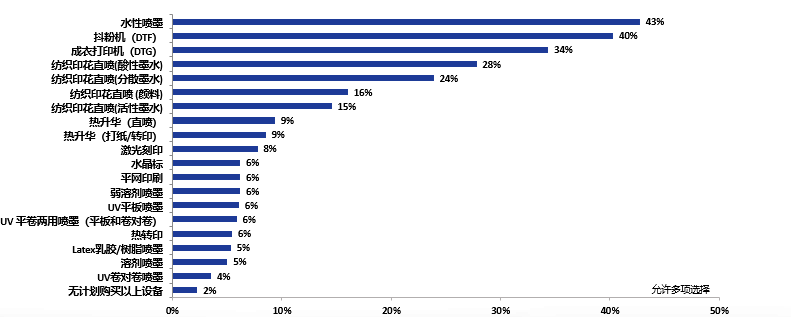
The picture shows the equipment purchase plan
The main driving factors for purchasing new signage and identification printing equipment include improving printing quality and increasing productivity. These motivations are highly consistent with industry competition pressure. Machines that can maintain high-quality output within a tight delivery cycle are preferred by customers.
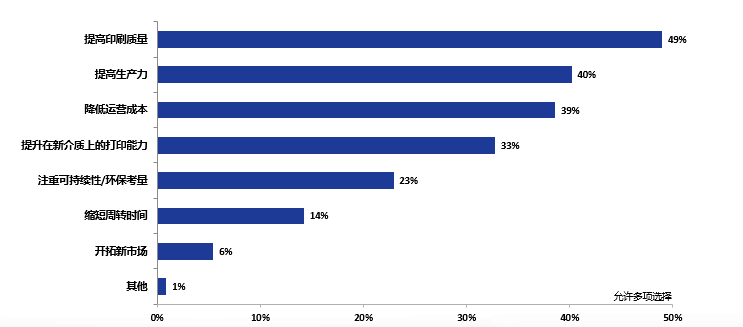
The picture shows the main driving factors for equipment purchase
Next, let's analyze the respondents who position themselves as promotional product printing companies. Among these enterprises, the most commonly printed products include bags/handbags (42%), glassware (37%), clothing (36%), and stationery (35%).
When asked about the production equipment used, respondents from promotional product printing companies most commonly mentioned ready to wear printing (DTG) and sublimation transfer printing. In contrast, the usage rate of UV printing is much lower. This technological preference reflects the market's demand for multi material adaptability and high-resolution imaging capabilities. Especially for sublimation equipment, it can achieve vivid color output on polyester substrates; DTG garment printing provides higher flexibility on cotton and blended fabrics.
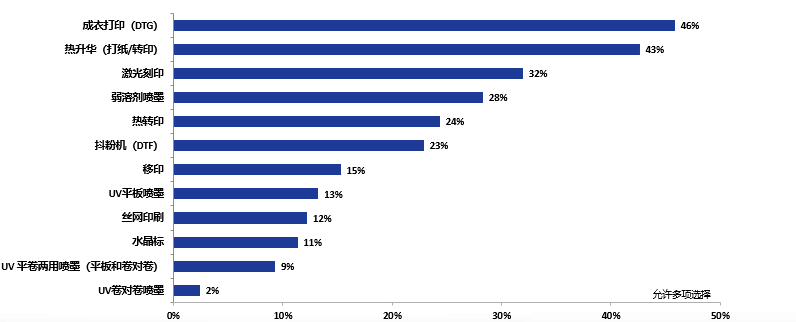
The picture shows the type of device usage
Similar to the situation of textile/clothing and label/identification printing companies, most of the respondents from promotional product companies stated that their printing volume has increased or remained stable over the past year. This trend further validates the resilience of this niche market and the sustained demand for customized promotional products under potential macroeconomic pressures.
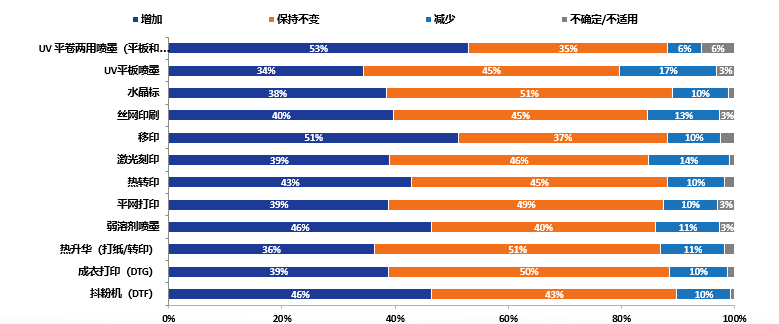
The picture shows the variation of device print volume
In terms of future procurement plans, promotional product printing companies most commonly plan to purchase ready to wear printing (DTG) or TikTok (DTF) equipment. This procurement behavior means that the market is developing towards a multifunctional platform that can simultaneously handle clothing and hard substrate decoration. At the same time, this also reflects the increasing interest of enterprises in hybrid business models that span traditional vertical fields.
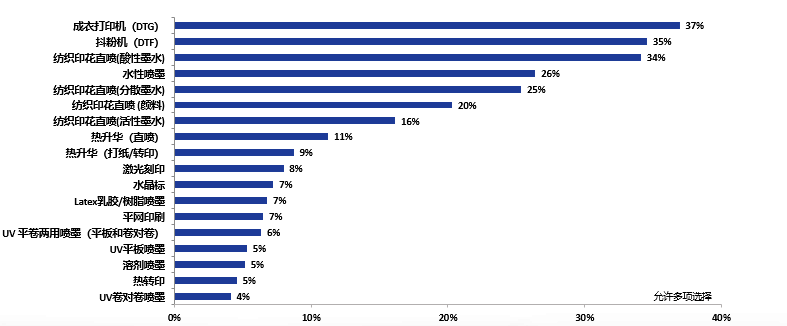
The picture shows the equipment purchase plan
The main driving factors for the procurement of new equipment are consistent with expectations, namely reducing operating costs, improving printing capabilities on new media, and enhancing printing quality. The consistency of procurement standards among various segmented markets indicates that competitive differences in the industry are increasingly determined by unit economic benefits and application diversity, rather than just production capacity.
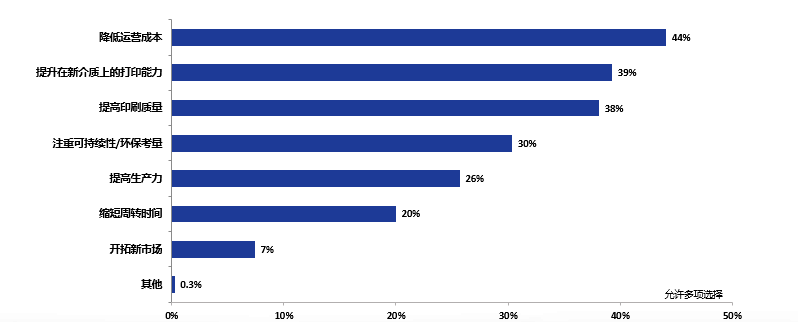
The picture shows the main driving factors for equipment purchase
Future outlook and summary
The coexistence of old and new technological patternsDTG/DTF equipment leads the short-term agile production upgrade, while traditional printing equipment still occupies the core segmented scenarios with cost and production capacity advantages。
Software and hardware upgrades for bidirectional accelerationEquipment procurement focuses on high ink efficiency, wide color gamut, and special ink functions; Pre press/RIP and 3D design software have become the focus of procurement, and digital tools have become the core infrastructure to solve production bottlenecks.
Reconstruction of Industry Competition LogicPrinting quality and service breadth have become the core factors for customers' choices, with a significant decrease in price weight and ability advantage replacing cost leadership as the core competitive logic.
4
Pain points drive automation transformationLabor shortage, tedious document preparation, and equipment downtime are the core production challenges in the industry, forcing enterprises to accelerate the implementation of automated integrated solutions.
Green development has become a standard in the industryOver 70% of enterprises have implemented formal sustainable development projects, with water-based ink and energy efficiency being the most concerned environmental indicators for customers, and green capabilities becoming the core competitive barrier.
6
Clear future development directionFlexible technology deployment, continuous process optimization, and compliance with environmental protection have become the core competitiveness of enterprises, and the industry's demand for modular and highly adaptable solutions continues to increase.
Source: CSA
Transferred from: Fashion Printing
Contact Us
- Address:Room 904, Greenland Center, Financial City, No. 662 Huangpu Avenue Middle, Tianhe District, Guangzhou City
- Phone:020-89300178/89300188
- Email:gzboya@vip.163.com
email subscription
- Click to subscribe to email now (industry news, exhibitor updates, etc.)
- submit
- I want to visit | Be an exhibitor | Cloud exhibition | Events
Follow us